Small Perler Bead Patterns: Sizes, Boards and Bead Counts
Compare eight original small charts, choose your first project and learn why a small pattern does not require mini beads. Real dimensions, colors and bead totals included.
Start from this guide
Open the editor to make a pattern now, or pick a public pattern to practice the workflow.
A small Perler bead pattern is a short grid you can check one row at a time. Our easy and cute collection contains eight original charts within 18×18 pegs, using three or four colors. Each fits one matching 29×29 square board for standard 5 mm beads.
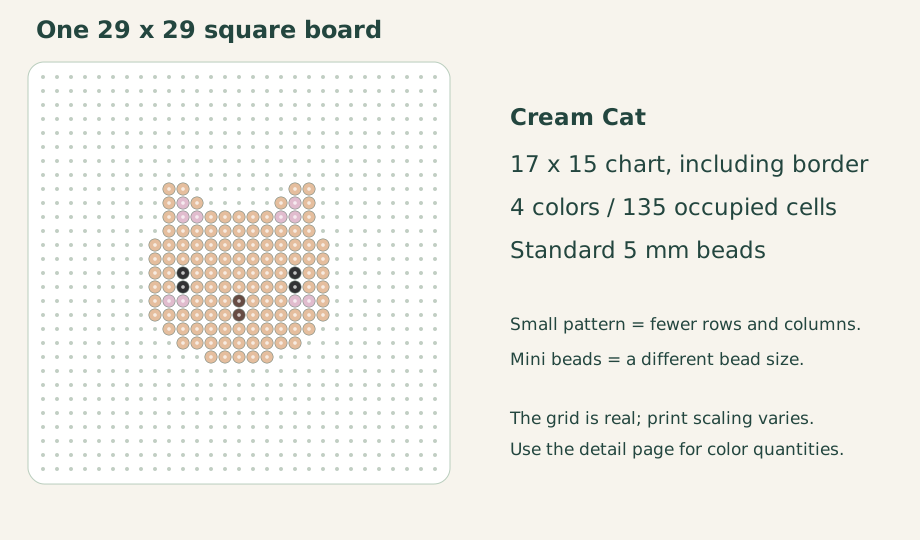
The illustration shows the Cream Cat grid centered on one board. Use it to check placement; print scaling may differ from your physical board.
Mini Perler bead patterns: small grids or mini beads?
The word mini can describe a small drawing or a smaller bead product. In this guide, mini Perler bead patterns are compact grids made with ordinary 5 mm beads. They fit one matching square board; you do not need smaller beads to follow these charts.
Mini beads are a different size, often around 2.6 mm, and need their own matching board. Check the bead packaging before starting. Keep bead sizes consistent within one piece and follow the manufacturer’s instructions if changing sizes.
A 17×15 chart includes empty border cells; it does not automatically use 255 beads. Count only occupied cells. Grid size also does not guarantee a finished measurement in inches: peg spacing and fusing affect the result.
Compare eight original charts
These counts come from the editable grids. Open a detail page for brand color IDs and quantities.
| Pattern | Grid, including border | Colors | Beads |
|---|---|---|---|
| Cream Cat | 17×15 | 4 | 135 |
| Pink Bunny | 17×16 | 4 | 112 |
| Honey Bear | 17×14 | 4 | 130 |
| Lemon Chick | 17×15 | 3 | 108 |
| Sweet Strawberry | 17×17 | 4 | 126 |
| Woodland Mushroom | 17×16 | 4 | 138 |
| Spring Tulip | 17×18 | 4 | 106 |
| Cloud Rainbow | 17×14 | 4 | 115 |
Kawaii Perler bead patterns and other cute ideas
For a kawaii-style face, start with a compact outline, simple eyes and a small nose. These three original designs offer different shapes:
- Cream Cat has pointed ears and pink cheeks. Keep the dark eyes and brown nose visible against the cream face.
- Pink Bunny has long ears, pink ear centers and a tiny red nose. Preserve the joins between the ears and head.
- Honey Bear has round ears and a cream muzzle. Keep the muzzle lighter than the surrounding head when recoloring.
All three use four colors. Count both sides rather than assuming perfect symmetry. For only three colors to sort, choose Lemon Chick; its beak and feet share orange beads.
Try strawberry seeds and mushroom spots when you are ready for scattered colors. The tulip uses fewer beads than the mushroom but has a taller, narrower shape. The smallest bead total is not automatically the easiest project.
Read the chart and prepare the beads
- Open the detail page; check width, height, brand and color quantities.
- Sort each listed color. Screen colors do not replace physical brand codes.
- Keep empty cells empty. White beads occupy cells and count toward materials.
- Build an outline or center line, fill the body, then check details row by row.
- Confirm that ears, stems and cloud bands connect before following the standard ironing guide. An adult should handle the iron.
Edit and export without losing the outline
Change the main color while preserving contrast around eyes and noses. Removing a connecting bead can detach an ear or leaf even if the preview still looks recognizable.
Export PDF for a labeled making reference or PNG for screen use. Visual exports follow the account's watermark rules. Print scaling changes paper dimensions, so these charts are not guaranteed to align under a physical pegboard.
FAQ
Are small Perler bead patterns suitable for beginners?
They offer fewer rows to check and fewer colors to sort. Choose a connected design and limited palette instead of judging only by bead count.
Do mini Perler bead patterns require mini beads?
Not always: mini can refer to either the drawing or the bead product. These charts use standard 5 mm beads. Choose chart dimensions and bead diameter separately; changing bead size also requires a matching board and the appropriate manufacturer instructions.
How can I recolor a kawaii Perler bead face?
Change the main face color first, then compare the eyes, nose, ear centers and cheeks against it. Preserve a clear light–dark difference around the eyes. Check the new brand color IDs and quantities before exporting, and keep the original ear-to-head connections.
Can these become keychains?
The base charts do not reserve hanging holes or include tested hardware. For a planned connection, see the keychain collection and inspect the cooled result before use.
What should I make next?
Try small animal poses, flowers and plants or four original Thanksgiving patterns. For a personal image, follow the photo-to-pattern guide.